The LINSTOR® Operator for managing the LINSTOR life cycle in Kubernetes is a Red Hat certified offering available through the OperatorHub in the OpenShift Container Platform. An Operator is a Kubernetes pattern that uses Custom Resource Definitions (CRDs) and Kubernetes principles such as the control loop to automate tasks. You might think of an Operator as a Kubernetes administrator entering management or life cycle commands, except in this case the administrator is autonomous and does not drink caffeinated beverages or need a 1 a.m. pizza delivery.
After installing the LINSTOR Operator, you can use it to easily deploy LINSTOR in Kubernetes or other based-on-Kubernetes platforms, such as OpenShift, K3s, minikube, MicroK8s, and others. The certified offering through the OpenShift OperatorHub assures you that the LINSTOR Operator has gone through a Red Hat process of testing and validation.
LINSTOR in OpenShift life cycle management
With the LINSTOR Operator installed in OpenShift, an administrator creates a LinstorCluster custom resource. The LINSTOR Operator responds by deploying the LINSTOR controller service container, a LINSTOR satellite DaemonSet on each storage node, the Container Storage Interface (CSI) driver, the high availability (HA) Controller, and loading of DRBD® kernel modules. Within the framework of the LINSTOR Operator, administrators can change custom resources to customize the LINSTOR deployment. For example, you can change the LinstorSatelliteConfiguration resource to customize per-node storage pools and properties.
The significance of a certified OperatorHub offering
The OperatorHub in OpenShift is a successor to the Red Hat Marketplace in OpenShift, which is no longer available as of 1 April 2025. The OperatorHub embedded in OpenShift has both Red Hat certified and community Operators.
Red Hat summarizes its certification as a way someone can know that an Operator is “validated, well-integrated, mature and supported.” The certification also assures that an Operator integrates correctly with the OpenShift security model. For example, the OpenShift OperatorHub certified offering of the LINSTOR Operator uses security context constraints (SCCs) to control permissions for the LINSTOR satellite pods in the OpenShift cluster.
Certifying an Operator for OpenShift
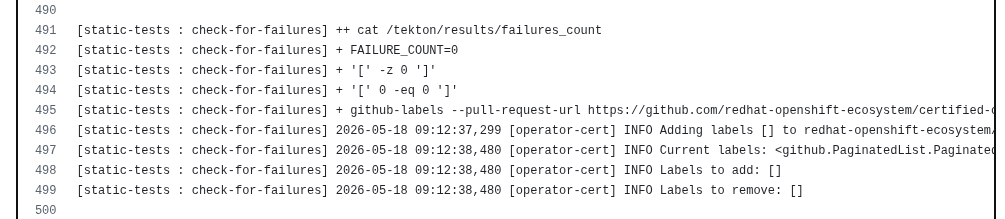
The process to certify an Operator for OpenShift and create an offering in the OperatorHub, starts by submitting a pull request to the certified-operators repository. Submitting a pull request triggers a sequence of tests that run in a pipeline. All tests must pass before an Operator will be accepted in the certified OperatorHub.
One of the things that the OpenShift OperatorHub certified version of the LINSTOR Operator does is to use official Red Hat Enterprise Linux (RHEL) images for the CSI driver sidecar containers. The LINSTOR Operator relies on these containers to do tasks such as provisioning storage volumes, attaching volumes to pods, and taking volume snapshots.
Conclusion
If you are interested in learning more about what the certification involves, you can read about the process in Red Hat documentation. You can find the results of the latest (at time of writing) merged pull request for the LINSTOR Operator in the Red Hat certified-operators code repository.