



Comparing Open Source Virtualization Platforms
More and more, businesses and companies are seeking to repatriate services and infrastructure from the cloud to on-premise or hybrid solutions. This might be for


Securing the LINSTOR Encryption Passphrase By Using systemd-creds and TPM 2.0
Before version 1.33.0, LINSTORⓇ did not have a method of entering the LINSTOR controller service master passphrase when the service was restarted unless it was

Controlling LINSTOR Replica Placement During Node Evacuation
When maintaining or decommissioning a group of nodes in a LINSTORⓇ cluster, it’s common to use the linstor node evacuate command to automatically relocate resources from one
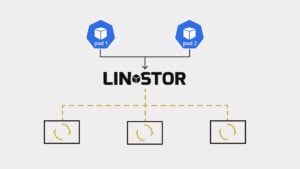
Creating ReadWriteMany Persistent Volumes in Kubernetes by using LINSTOR
With the release of LINSTORⓇ operator 2.10.0 for Kubernetes, users can create ReadWriteMany (RWX) Persistent Volume Claims (PVCs) directly using the LINSTOR CSI driver. This

Homelabbing LINBIT Storage Solutions
One of the benefits of using open source software such as the storage solutions that the LINBIT® team develops is that you do not need


How to Setup LINSTOR on Proxmox VE
Authors: Ryan Ronnander & Roland Kammerer — In this technical blog post, I will show you how to integrate the open source software-defined storage (SDS)
Setting Up Highly Available Storage for Proxmox Using LINSTOR & the LINBIT GUI
This article is a companion article to “How to Setup LINSTOR on Proxmox VE”. Instructions in this article will guide you through installing and integrating LINSTOR®
Implementing Disaster Recovery for Proxmox VE with a Stretched LINSTOR Cluster
In this blog, you will delve into the necessary steps and settings for creating a stretched LINSTOR® cluster to provide disaster recovery (DR) capabilities for


AWS Outage & LINBIT Software Updates for Kubernetes
We recently witnessed an AWS outage. I then saw an article that called for European digital sovereignty in the context of the outage, but those

LINBIT CEO & Developers to Present at CloudStack and Kubernetes Focused Conferences
Members of the LINBIT® team will speak at upcoming conferences, focused around cloud, virtualization, containerization, and orchestration technologies. LINBIT CEO and DRBD® creator, Philipp Reisner,
Fraudsters & Technology
AI technologies are changing our world quickly. Of course, fraudsters also adopt these technologies and create increasingly sophisticated CFO scams. Recently, my CFO shared an
Reduce Contractual Risk with Open-Source Software
In a recent conversation with Doug Milburn, CEO of 45Drives, I picked up the term ‘contractual risk’. You add to the contractual risk of your organisation
Configuring Highly Available NVMe-oF Attached Storage in Proxmox VE
LINBIT® develops and supports software used to build high availability clusters for almost any application or platform out there. It does this by creating tools
Project Updates & New Features
I will use this newsletter edition to share progress on projects that we will release soon. The first one the team has been working on

Backing up and Restoring Kubernetes Workloads by Using CloudCasa with LINSTOR
This article overviews some of the features and benefits of using the CloudCasa™ data protection platform for Kubernetes with a LINSTOR® deployment in Kubernetes, and

Creating SUSE Harvester Persistent Storage with HA & DR Capability by Using LINSTOR
SUSE Harvester is an open source hyperconverged infrastructure (HCI) virtualization management platform, built on top of Rancher, the SUSE-developed management platform for Kubernetes. Harvester deployments
